Late-night musics, ideas for a frozen world, an iced-over New York City.
mp3
Wednesday, October 08, 2008
Hey, Does This Thing Work? or Communism Rocks!

It's Spelled "Dickensian"?!?! Huh.
All this time I had only heard the word "Dickensian" spoken but had never seen it spelled until now. If you asked me yesterday how to spell this word, I think I would have guessed "DeKensian" or something. In the process of adjectivizing this proper noun, the emphasis ended up on the wrong syllable. Consequently, I didn't really know what this word meant until now either, and of course seeing it in print immediately clued me in to its meaning. I always just kind assumed from context that it meant something kind of old and impoverished.
This explains why Michael Showalter uses the word Dickensian to describe one of the alternate names for restless leg syndrome, "sewing machine foot."
Now I know what I'm going to say when a Mad Lib asks for an adjective. I used to always just say "poopy," but now I have something really good.
Thursday, October 02, 2008
About the Song "Blues Subtitled No Sense of Wonder" by Gastr del Sol
Listen: The first time I heard the song "Blues Subtitled No Sense of Wonder" by Gastr del Sol I was completely and utterly blown away. It left this lingering surreal feeling for the entire rest of the day.
This time I'm writing about just one song. I don't really know if I have a favorite song, but when people ask me if I do, I usually just go ahead and say that it's this one, because no song has ever felt so singularly powerful and overwhelming.
The song starts off not unlike a lot of other Gastr del Sol songs, you get the sense that this song might be a little like "The Relay" or another piano-as-vehicle Gastr del Sol song. And that alone was fine, because I love it when David Grubbs plays the piano in that cryptic, slowly understated style. He slips in and out of scale in a way that makes my brain feel as if it is being fed a balanced, nutritious meal. It's really nice. So the song goes on.
All of the early first three minutes of the song kind of drone and flicker along, until out of nowhere this strange building starts to pick up, as if the song up until that point is just a guy sleeping, and then suddenly some beam comes and sucks him out of his bed and into the air like an alien abduction. I am surely missing the point with this analong, but I think it's safe to say that the main thing that anyone remembers about that song is when this "launch" occurs. At 2:55, everything comes in so big and throbbing, harmonized vocals, some kind of organ, the persistent faint electronic blipping in the background, the horns, the gurgling synth bass, the intensely vibrato'd strings, and the piano - the piano playing pretty much the same as it was at the beginning of the song, but given new context by the pedal tone of the synth bass and the strings that sound like blood flowing out of a slit wrist. It's a very intense song. When I heard this part of this song, I thought to myself "This must be what it feels like to be on heroin." As if the pain and joy of the entire world was contained in the beautiful experience I was having right at that moment, but it was neither sad nor happy, just magnificent in its being.
This surprise ends with an organ solo. A very strange organ solo. It sounds like they invited some guy who just really wants to rock out, like someone from the Saturday Night Live band was invited to come in and take an organ solo. I guess it's a surprise inside a surprise.
Like most of Gastr del Sol's songs, the lyrics, when taken from a traditional view of "song" they make about zero sense:
most blues are subtitled
either no sense of wonder
or no sense of scale
for example, there's a routine, subtitled I have no idea how long
subtitled I don't care how long, subtitled why not untitled
I have dozens of titles
Hmmm... Taken out of context, they make no sense, but when viewed from the lens of the rest of Gastr del Sol's work, it is actually relatively heavy and emotional. It's as if a person you knew to be autistic his whole life one day just broke out of that shell and just really leveled with you: It was still kind of coldly cryptic, but you could find so much life even with so little to go from. Perhaps this is why this album marks the beginning of the end of Gastr del Sol. Until Camofleur, Gastr del Sol might as well have been being making music that was obscure on purpose. It was music for people who knew a lot about music, kind of a meta-music that spoke to the guy in your town who only listened to bands nobody had heard of (it's important to note that they accomplished this in the era before the internet, when a wide knowledge of music was not simply a matter of how many "similar artists" you could download and fit on your hard drive, music was about discovery in a much more meaningful, social sense). You see, Camofleur, despite being weird, was a relatively pop record. More about this pop business later.*
What I thinks helped shape my experience of hearing this song was the fact that I heard it out of context from the rest of the record. For many months I only had access to this one song. It was not prefaced by the pretty cool song "The Seasons Reverse" and it certainly was not followed up by the supreme boner-killer known as "Black Horse" (I am about 100% sure this song was Grubbs' idea, to quote Werner Herzog in Julien Donkey Boy when he hears his son's poem at the dinner table, "I think I hate it").
"Blues Subtitled No Sense of Wonder" ends even more quietly than it begins (are those wind chimes I hear at the end?), with a refreshingly crowd-pleasing major lift, but in the wake of Gastr del Sol, we are to realize that this is pretty much the last of that truly grand, mysterious David Grubbs style of piano playing.
*It comes as no surprise that Grubbs and O'Rourke's solo work after Camoufleur both represent more pop manifestations of themselves, although the execution of their newfound freedoms came across in distinctly different ways.
The Thicket, David Grubbs' first major post-Gastr offering was not bad, but just about completely forgetable. Nobody has talked about this record since the year after it came out. It was just so incredibly white, in a way that only a grad student could like. The worst thing about this album was probably the lyrics. The abstract words that once went well with the weird fragments of Gastr del Sol now just sounded like the most boring guy in the world trying to find a rhyme. I know I may be sounding harsh here, but it was as if someone had taken all of the things that I liked about David Grubbs and turned them off, leaving only some weird professor in his place. And the person who had turned these things off was Grubbs himself. Yikes. No piano! I loved his piano. Ever heard of a record called Arise Therefore? He even made Will Oldham sound brilliant and dangerous with his piano notes, solidifying Oldham's standing as a voice to be taken seriously, at a very crucial time in his career.
The rest of David Grubbs' work after that? I don't know. There was that album after that, whatever it was called, the one with all the puns in it, but again, it was just too normal, too academic, too boring. Don't get me wrong. I think that David Grubbs is absolutely brilliant. He is in part responsible for some of the smartest, weirdest, and coolest sounds I have ever heard, and I don't know if he looks back at that stuff and thinks it's immature, but I'm afraid the dude will never be the same again.
In my opinion, unlike The Thicket, Eureka by Jim O'Rourke was brilliant, it was a revelation because it was good, and because O'Rourkes solo work up until that point, while vast and extensive, had been far from pop, it was more like book reports on the smartest, most serious musicians of the past 100 years. That's why hearing Eureka was such a (for lack of a better term) "eureka" moment. It's name was so refreshingly unironic. Eureka was smart, listenable, weird, and funny. It was so powerful because it was like seeing Stravinksy singing showtunes: In my mind, an integral part of the whole experience of listening to Eureka was that the pop contained therein could not be separated from the context of the man behind it.
It appeared as though O'Rourke had done something more revolutionary than the sum of his most obscure, challenging work by making something so beautifully personal and listenable, until he kept doing it, with records that became less and less fresh as the pop contrast to his avant-garde roots became less of a surprise (Halfway to a Threeway, and whatever that classic rock-ish one after that was) and more just like regular music.
Perhaps that is why Jim O'Rourke identifies with Japan. His transparency in music shares many parallels with Japan's approach to what the rest of the world has to offer. Jim O'Rourke is just as much a curator as he is a musical immitator, in the same way that Japan inhales foreign culture, industry, and science with a voracious appetite: Immitating it while disregarding what the rest of the world has declared associations and mutual exclusives. Why can't an avant-noise guy make a perfect pop record? Why can't you put put natto on spaghetti? Regardless of how they do adopt foreign ideas, what comes out is distinctly Japanese, and in the same respect, regardless of what type of music Jim O'Rourke makes, there's a competence and sophistication to it that is so distinctly and undeniably Jim O'Rourke. Now he lives in Tokyo, has pretty much given up on music so that he can concentrate on making films. I'm sure that his movies will exude the same distinct flavor that can be found in all the music projects he worked on.
But back to Gastr del Sol. I think what we have here is a classic tale of why two great minds often can't work together for very long. They had their good moments together in Gastr del Sol, but ultimately, they were just too strong of forces to work together for too long. It would be like if Yasujiro Ozu and Federico Fellini were forced to make movies together. They might make some really awesome stuff, but you could be sure that it would not last. Sadly the role of the visionary is usually fulfilled by just one person, and the rest must have the capacity to either follow or withhold their own visions. Whether or not that is a good thing seems to be an eternal question, but what is certain among those who have seen it is that the force of creative direction is too strong to keep people together, at least for Americans.
Until the next group of musicians too momentarily young and idealistic to realize they are too smart for each other comes along, we are left with glimpses like this, small moments when the elements combine in beautiful, mysterious bliss.
USA: Still #1 in... What?
So I was just talking to my friends David and Jennie Orr about the US economy, and I asked what the US was number one at anymore. What does the US export to the rest of the world? What do we sell more of to other countries than we buy from other countries? What does the US make that the rest of the world wants? I guess that's one thing that has been good about Obama's speeches, is that he realizes that the new global economy is not the same as the old one, and that the US could quite possibly get left in the dust, which is why he is focused on education that is designed to be able to compete in the global economy.
Here's how I see it: We will not be able to compete in traditional manufacturing industries on a global level anymore at all. There are just too many other places where it's cheaper to get most things made. If the natural resources can be found near China or the necessary parts can be shipped cheaply to China, they're going to get those jobs. You cannot compete with a billion people willing to work for very low wages. Sad, but true. Or is it?
With the spread of globalization, it's just fundamentally not the same game. Yes, lots of people are out of jobs as a result of this change, but the global corporate economy has made an irreversible change, it's not really going to come back. Nobody thinks that the US is going to return to kick butt as an auto manufacturer (at least, in the traditional, gas-powered sense), yet people talk about keeping jobs in the United States, but the truth is that the jobs that have left will not come back, and people had better have a pretty good idea of what sorts of jobs can be made that have staying power here at home. And that's where I think B.O. (whoa, his initials are B.O.!) gets it right, is that if the US doesn't get cracking in the New Energy industry, the post-oil industry, whatever you want to call it, we will get left sorely behind.
But hey, for the sake of a pep talk, let's identify what game we DO still have.
So in what areas does the US still kick butt?
- Basketball. We are still pretty good at this. And maybe baseball too. Maybe.
- Rappers. We've still got some good ones, I guess. But the rest of the world is gaining on us. To expand this idea, I guess you could say that general popular culture is a major export. Musicians, writers, some artists, some academics, and some other peddlers in the idea trade still have some impact, but that is starting to change as well.
- Movies. Regardless of their quality, we make a lot of movies. And people watch them, even in other countries.
- Computer operating systems. We've got Microsoft. Like it or not, it's still on most of the world's computers. But aside from software, which is a relatively fluid idea that can be copyrighted and sold (or more likely, copied) throughout the world, the real problem is that a large portion of the hardware is not produced here in the US. We've got Apple, with their iPods, and their gain in the personal computer market, but pretty much nothing that they design is made in the US. It all says "designed in California" but it is certainly made in China, bringing a considerable amount of money to the top people at Apple, but providing jobs for a few of the billion people in China. Contributes to the trade defecit, what else is new.
- Science. Sort of. We don't even have a large hadron collider though.
- Space program. I guess, but I mean, even China has one now.
- Oh, I got one: Broadway musicals. But that's kind of like American football, ya know. It really only exists here.
- The medical and pharmaceutical industries. Sure, we have some good stuff, but not everyone can use them.
- Two words: Will Smith.
- Another two: Mariah Carey.
- This sort of goes with exporting culture, but I also think we export our version of the English language. But, we can't make nay money off of this because people get on Napster or Friendster or whatever and download and steal it, for free! We have GOT to copyright our accent or something.
- Oh, how could I forget: Fast food! And other junky snacks.
- Making cars. Just kidding.
- Google. We've got Google. Those colorful, rollerblading, Segway-riding, free-delicious-food-eating brainiac billionaires over in CA. Let's hope they don't relocate. Or more importantly, let's hope California doesn't declare independence from the rest of the US. So let's say this:
- We have California (for the time being). What's to keep them from succeeding from the rest of the US and taking Schwartzeneggar as their president? I mean, seriously. If you think about it, the rest of the US (with the possible exception of New York, maybe Chicago) is kind of dragging California down. California's political and economicl ideology is way more progressive than the rest of the US, and frankly, I think they might be getting sick of us. Is it a surprise that it says "Designed in California. Assembled in China" on the back of your iPod? Designed in California, not the United States. They're just getting a head start on the succession.
- So more generally, we have the Silicon Valley and everything associated with it. Again, while ideas are exported throughout the world, the hardware that acts as a platform for these ideas is increasingly manufactured elsewhere.
- I think we still make microchips here, maybe?
- Weapons. Bombs. Airplanes. When it comes to military spending, we are number one. Yikes.
- We can't even win at competetive eating anymore.
- We're good at making prisons. And TV shows about hunks who break out of them!
Wednesday, October 01, 2008
Sunday, September 21, 2008
The Mental Environment: Never Free of Suggestion, But Still Kinda Fun
I was talking today about how much I like going to the grocery store, even though when it comes right down to it, the whole experience is engineered so that products will scream at you, typically encouraging you to purchase things you don't need. I would say that on any given trip to the grocery store, I purchase less than 1% of the total items that are offered to me, and I rarely make decisions that aren't in accordance with the many lessons I learned from going to the Jewel grocery store with my dad on Saturday mornings every week for about six years as a child. Buy generic when quality is negligible, buy larger quantities for less if you are sure you will use it all, buy with specific meals in mind, make your shopping decisions premeditated, have a list, etc. I have always said that if you want to get to know the culture of a group of people, visit their grocery stores. That's one of my old quotes.
I also really like ads. In a way, grocery stores are like just big rooms full of ads. Ads don't usually talk me into buying anything, but I'm always kind of entertained by what they seem to think people want. For example, it tickles me to see ads for labor-saving inventions in which the people doing it the old way are having a real heck of a time. For example, in the commercial for that thing that quickly coils your garden hose for you, there's this guy who is just having the hardest time ever coiling his garden hose. The announcer says in that one voice (and it is one voice, just like Don LaFontaine [RIP] was the only voice in the game for movie trailers) that says "Tired of pulling and untangling to get your garden hose coiled?" And the guy is like having the world's hardest time getting his hose in order. He's making this face like "surely there must be a better way!" You know the routine. The form of these commercials are about as automatic to Americans as the form of a knock-knock joke.
But I try to watch TV like a sociologist. Taking this intellectualist stance makes me feel way less guilty about watching bad TV all the time. Here's my analysis:
These ads attempt to create a need by greatly exaggerating the difficulty of what is usually a trouble-free task. Places like SkyMall base their entire business on products like this (don't get me started on SkyMall, I'm in the process of creating a whole blog devoted just to the celebration of the triumphs in ad copy found within this masterpiece of despair/catalogging).
But what has really been getting me going lately has been a few original ads that I have seen posted in windows around Bloomington.
Exhibit A:
If you live in the US and aren't a Republican, it doesn't get much better than this. A joke wrapped within an innuendo cuddled inside another joke. In fact, regardless of political affiliation, I think it's brilliant simply because it implies that they are so sick of people coming in asking whether or not people have the Sarah Palin frame (I always thought it was frames, but I guess the professionals at Optiks would know best when to pluralize this word). Truth be told, it's quite possible that nobody has asked for the S.P. frames, but they went ahead and ordered a bunch and now they want to let people know by making it seem like they get asked about them a million times a day. I love it.
Exhibit B:
This one requires a little bit more pop culture history than the last one. Bear with me though, the payoff is immense. The name Michael Winslow alone might not ring a bell for most Americans, but when you call him "the guy who made the funny mouth noises in the Police Academy movies," you get an overwhelming amount of "Ohhhh yeah!"s from people over the age of 25. Well, he has had a small surge of renaissance-ironique (just made that term up, probably not real French, but I think that it describes a very specific thing that seems to be happening lately) with his recent appearance in a Geico auto insurance commercial. No idea what he has been doing in the past fifteen years leading up to that Geico commercial, but the fact remains: Dude makes some incredible noises, using just his mouth. Apparently he is funny, because he's coming to Bloomington for three days, to kick off the opening of Bloomington's first full-time comedy club, The Funny Bone.
I'm kind of jazzed that there's a comedy club opening up in Bloomington. I've always enjoyed comedy albums, although I've never really been to an actual standup show (unless you could this one time when my Sunday school teacher Paul Baltes did his routine at the church youth conference, it was somewhat controversial because there were fart jokes). I've been listening to the Michael Ian Black disc as well as the new Mitch Hedberg posthumous release, and I must say, these comedy albums merit repeated listenings. This comedy is really good stuff.
The Funny Bone has the distinction of being named a name so obvious that as soon as you hear its name, you are pretty much sure that there are at least five other comedy establishments with the same name in existance.* (Google it, it's especially unfortunate that one of the other Funny Bones is in Bloomington, IL instead of Bloomington, IN.) But they have a real bang-up schedule planned. We've got Michael Winslow, then Christian Finnegan from Best Week Ever (I truly do love that show), and then... (drumroll please) - Dustin Diamond, a.k.a. Screech from Saved by the Bell, a.k.a. Dustin Diamond, the sleezeball who did porn and acted like a complete fool on a couple of reality TV shows. The Funny Bone will also being starting an open mic night, and I hope to see local funnyman Dave Segedy test out his comedic stylings there. Heck, I might even try and put something together, how bad could it be? Just you wait and see.
I will defintely be there to see Michael Winslow, because he is the living master of a craft that may soon be extinct. Plus, he just seemed like such a cool guy in those Police Academy movies. Screech, not a chance, Christian Finnegan, maybe.
* Kind of like if someone told you their heavy metal band's name was Doomsday or something. Instead of saying "cool!" my first reaction would more likely be "Wait, are you sure that name's not already taken?"
Thursday, September 11, 2008
タンポポ
Tampopo! I watched this movie again tonight for the first time in many years, and it's still as brilliant of a movie as I had remembered.
This time I think that I was most impressed by the small subplot where the man comes rushing home to find his wife on her deathbed, and he commands her to arise and make dinner. She somehow stumbles to her feet, makes her way to the kitchen, and somehow makes dinner while looking like a bit of a zombie. The kids set the table, and the husband, the doctor, and the nurse all look on in amazement as she brings the food to the table. The family serves themselves and they begin to eat, and the mother collapses, the doctor proclaims her dead, and everyone starts crying. Then the dad insists that his children all keep eating, because this was their mother's last meal, and they had to eat it while it was still hot. The picture of people crying while trying to eat is really stunning. A powerful feeling is conveyed in this scene.
My old favorite part used to be this: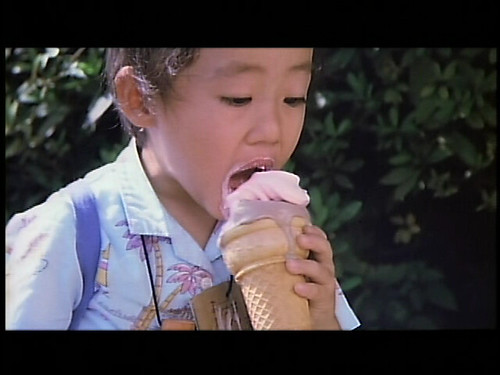
I mean, just look at how enormous that ice cream cone looks in his little hand!
When the man, after going to the dentist to get an abscess removed from his tooth, gets an ice cream at the park where he meets a very young boy wearing a sign around his neck that says "I am being raised on natural foods, please don't feed me anything sweet or any junk food."
The man hands the boy the ice cream cone, and the boy seems to hesitantly pump his hand with a confused sense of excitement. Finally, the little boy really digs in, smothering his face with ice cream, and the moment is the gastronomical equivalent of Adam and Eve eating the forbidden fruit. This boy has left bliss, and now knows the difference between good and evil foods. It is truly a wonderful moment in food cinema.
For some reason I seemed to remember the movie ending with the yakuza guy telling his girl about the legendary yam-filled boar intestines, but I was surprised to see that the movie actually ends with a very long shot of a baby breast feeding in the sunlight. Man's obsession with food comes full circle. I truly like that.
Monday, September 01, 2008
Monsieur Mo Rio - "Promenade" Video
There will be more about this Moritz fellow and Monsieur Mo Rio later, but for now, enjoy 1:44 of odd and pretty:
P.S. My high school promenade was nothing like this.
Sunday, August 31, 2008
More Bizzare Search Hits - Googlooping Ammo
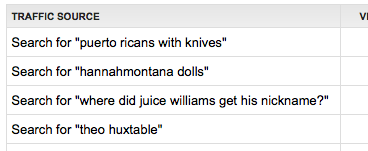
Oh, the search-based hits keep getting better and better. For the sake of Googlooping, here's a review:
- Puerto Ricans with knives. Like the ones in West Side Story perhaps?
- Hannah Montana Dolls. Those things are hard to find, kind of like Cabbage Patch Kids during the Christmas shopping season of 1984, or was it 1985.
- Who is Juice Williams? I have no idea, but Dave Chappelle was just on TV just a few hours ago talking about how black people don't know what juice is. Black folks, all they want is purple drink. Oh, that funny man, Dave Chappelle.
- Theo Huxtable. Remember when his family gave him one heck of a reality check when he said he was just going to be a model when he grew up? Is it messed up that (even as a kid) I kind of enjoyed seeing his naive dreams of being a model get crushed?

Subscribe to:
Posts (Atom)